On this page
If you're waiting 60 days for a payment certificate, your RA bill process is broken.
In Indian construction, the Running Account (RA) Bill isn't just paperwork – it's your cash flow lifeline. Get it right, and you pay your labour on time. Get it wrong, and you're chasing signatures while your concrete supplier stops deliveries.
This guide walks through the complete RA bill workflow from joint measurement to final certification. Whether you're a site engineer holding a tape measure or a contracts manager tracking retention, these are the steps that actually work on Indian job sites – from CPWD infrastructure projects to private high-rise developments.
What is an RA Bill and Why It Controls Your Cash Flow
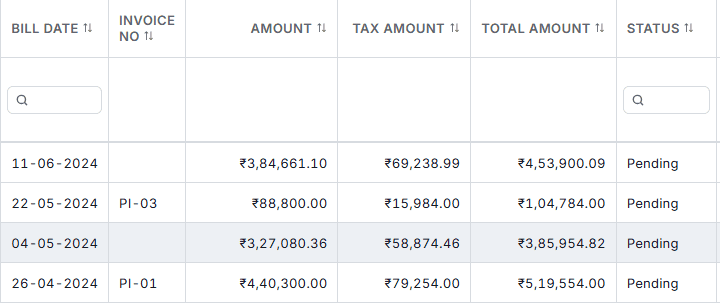
An RA Bill (Running Account Bill) is your periodic payment claim for work completed during a specific month. Unlike the final bill that closes the contract, an RA bill is a running tally of cumulative progress against your Bill of Quantities (BOQ).
How RA Bills Work in Practice
| Feature | Reality on Site |
|---|---|
| Frequency | Monthly, usually for work up to the last day of the month |
| Basis | Physical progress measured and jointly verified |
| Deductions | Security deposit, advance recovery, TDS, GST adjustments |
| Cumulative | Each bill adds to the previous – errors compound fast |
| GST Compliance | HSN codes, tax rates, and reverse charge must be spot-on |
Here's the hard truth: a delay in RA bill certification doesn't just hurt the contractor. It disrupts the entire project momentum. When payments stretch from 30 days to 90 days, subcontractors disappear, material quality drops, and disputes escalate.
Who Actually Handles What: The RA Bill Chain
One missed handoff between these roles can cost you two weeks:
Contractor's Site Engineer Records daily progress in the Measurement Book (MB), coordinates joint verification with the client's rep, and gathers photographic evidence. This is where most billing disputes start – with a dimension written down wrong.
Quantity Surveyor (QS) Translates field measurements into billable quantities, prepares abstract sheets with BOQ rates, and calculates deductions. The QS catches arithmetic errors before they reach the client.
Project Manager Reviews bill completeness, negotiates disputed quantities, and tracks payment timelines. When the client sits on a bill, the PM applies the pressure.
Client/Owner Representative Conducts joint measurement verification, reviews certifications, and issues payment advice. This person's signature is what releases the bank transfer.
Finance/Accounts Team Verifies GST compliance, processes TDS deductions, and maintains the contractor's advance ledger. They'll reject a bill instantly if the HSN codes don't match.
Before You Start: The Document Checklist
Don't draft a single line of the bill until you have these in hand:
| Document | Why You Need It | Source |
|---|---|---|
| Work Order / Contract Agreement | Establishes scope, rates, and payment terms | Contract file |
| Approved BOQ | Your rate bible | Tender documents |
| Previous RA Bill (Certified Copy) | Shows cumulative quantities to date | Last month's file |
| Joint Measurement Book | Legal record of physical work | Site engineer |
| Material Delivery Challans | Proof for supply-based claims | Store keeper |
| Quality Check Certificates | Evidence work meets specs | QA/QC team |
| Advance Receipt Vouchers | For calculating recovery deductions | Finance |
In Superwise, these documents link automatically through the document management system, so when a client asks for that February cement challan, you're not digging through filing cabinets.
Step 1: Joint Site Measurement and the Measurement Book
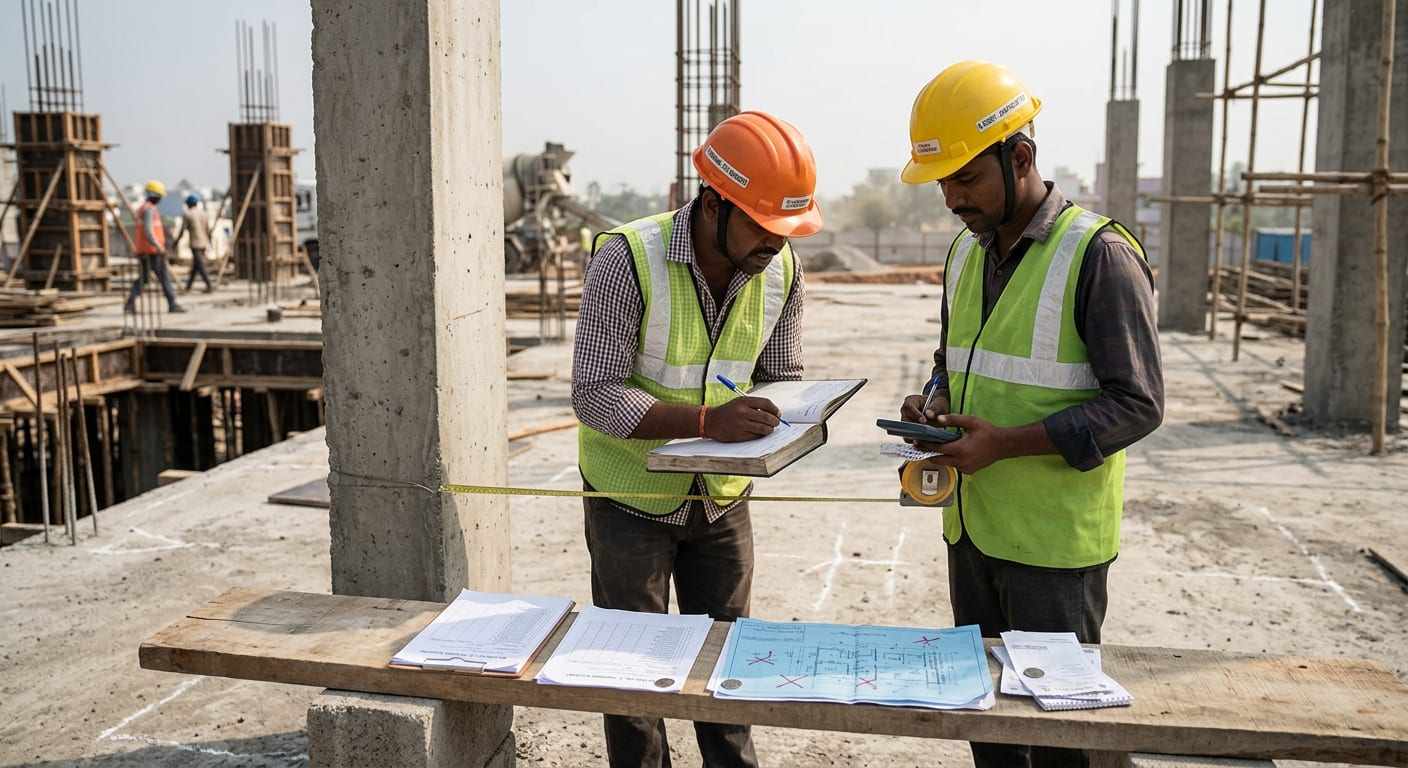
The RA bill starts with a tape measure and a witness. Never measure alone.
How Joint Measurement Actually Works
Schedule it early. Request joint measurement from the client's representative 3-5 days before the billing period ends. Don't wait until the 30th.
Measure together. Both parties physically verify: - Earthwork volumes (L × B × D) - Concrete quantities (from formwork dimensions, not just drawings) - Reinforcement steel (actual weighed quantities) - Masonry and plastering (measured surface areas)
Record in the MB. The Joint Measurement Book entry must include: - Date and weather (matters for earthwork compaction) - Location with drawing reference - Item description matching BOQ - Dimensions with calculation - Signatures of both representatives
Real Measurement Entry Example
Date: 15-11-2024
Item: PCC M20 (1:1.5:3) for footing
Location: Block A, Footings F1-F12

L = 12.50 m | B = 8.30 m | D = 0.15 m
Quantity = 12.50 × 8.30 × 0.15 = 15.56 cum

Contractor Rep: _________________ (Sign)
Client Rep: _________________ (Sign)
Photograph everything. Date-stamped photos of each measured location are your insurance policy when quantities are disputed three months later.
The digital measurement book lets site engineers record this directly on mobile devices with GPS tagging – no more illegible handwriting or lost notebooks.
Step 2: Abstract Sheet Preparation (Where Errors Multiply)
The abstract sheet is your bridge between field measurements and money. Get the arithmetic wrong here, and the client will send the whole bill back.
Abstract Sheet Structure
| BOQ Item No. | Description | Unit | This Period Qty | Cumulative Qty | BOQ Rate | This Period Amount | Cumulative Amount |
|---|---|---|---|---|---|---|---|
| 1.1 | Earthwork excavation | cum | 245.00 | 1,245.00 | ₹320 | ₹78,400 | ₹3,98,400 |
| 2.3 | PCC M20 | cum | 15.56 | 45.20 | ₹4,850 | ₹75,466 | ₹2,19,220 |
| 4.1 | RCC M25 | cum | 28.00 | 156.00 | ₹6,200 | ₹1,73,600 | ₹9,67,200 |
Critical checks: - This Period Quantity: Only work executed this month - Cumulative Quantity: Running total must match previous bill + current claim - BOQ Rate: Never deviate from the tender rate unless you have a written variation order
Step 3: Drafting the RA Bill Document
Now formalize the abstract into the contract's required format.
Essential Components
Bill Header Project name, contract number, contractor PAN, RA Bill number, and period covered (e.g., "For work executed up to 30-11-2024").
Summary Section - Gross amount for this period (from abstract) - Amount upto previous bill (already certified) - Since previous bill (current claim)
Itemized Breakdown Reference every item to the BOQ number. Narrative descriptions should be specific: "RCC M25 for slab at Level 3, Block B" not just "Concrete work."
Deductions Schedule - Security deposit/retention (typically 5-10%) - Advance recovery (per contract terms) - TDS as per Income Tax Act - GST adjustments
Net Amount Due Gross amount minus deductions, written in figures and words.
Step 4: Handling Deductions Without Mistakes
Arithmetic errors in deductions are the fastest way to get your bill rejected.
Retention Money
Typically 5-10% of each bill, capped at 5% of total contract value.
Contract Value: ₹5,00,00,000
Retention Rate: 5%
Maximum Retention: ₹25,00,000

If cumulative certified work is ₹1,00,00,000:
Retention withheld = 5% of ₹1,00,00,000 = ₹5,00,000
(Still below cap, so full 5% deducted)
Advance Recovery
If you took a mobilization advance, the contract specifies recovery rates – often 20-25% of each bill until cleared.
Mobilization Advance: ₹25,00,000
Recovery Terms: 20% of each RA bill

Current RA bill gross: ₹15,00,000
Advance recovery = ₹3,00,000
TDS (Tax Deducted at Source)
As per Section 194C: - 1% for individual/HUF contractors - 2% for other contractors - 10% if PAN not provided
TDS is calculated on the gross amount before retention.
GST Compliance Checklist
- [ ] HSN codes match BOQ items exactly
- [ ] 18% GST applied correctly for construction services
- [ ] Reverse charge mechanism (RCM) noted if applicable
- [ ] Input tax credit (ITC) documentation attached
- [ ] Invoice format complies with GST rules
Step 5: Internal Review (The Friday Afternoon Check)
Before this goes to the client, run through this checklist:
| Check Item | Verified By | Status |
|---|---|---|
| MB entries complete and jointly signed | Site Engineer | ☐ |
| Abstract sheet arithmetic double-checked | QS | ☐ |
| BOQ rates cross-referenced with tender | QS | ☐ |
| Previous bill cumulative amounts carried forward correctly | Billing Team | ☐ |
| Retention calculations checked against contract cap | Finance | ☐ |
| GST invoice format validated | Accounts | ☐ |
| Supporting photographs attached | Site Team | ☐ |
| Client's previous queries resolved | PM | ☐ |
Attach these documents: 1. Joint Measurement Book copies 2. Abstract sheet with calculations visible 3. Previous RA bill certified copy 4. Material delivery challans for supply items 5. Test certificates for concrete/steel 6. Photographs with date stamps 7. Approved variation orders (if claiming extra items)
Superwise's approval workflows enforce this checklist digitally – bills above certain thresholds automatically route to senior management before submission.
Step 6: Submission to Client
Presentation matters. A messy submission invites scrutiny.
Covering Letter Format
[Contractor Letterhead]

Date: [Date]
To: [Client Name/Project Manager]
Project: [Project Name]
Subject: Submission of RA Bill No. [Number] for Period [Dates]

Dear Sir/Madam,

We hereby submit RA Bill No. [Number] for work executed from [Start Date] to [End Date]:

Gross Amount Claimed: ₹[Amount]
Less: Deductions: ₹[Amount]
Net Amount Claimed: ₹[Amount]

Enclosures:
1. Abstract sheet
2. Measurement book copies (pages __ to __)
3. Supporting photographs
4. GST invoice (No. ___)
5. Quality certificates

Requesting early certification.

Yours faithfully,
[Authorized Signatory]
Submit both physical and digital copies if required. Get a receipt acknowledgment – always.
Step 7: Client Verification and Re-measurement
Now the waiting begins – but you can influence the outcome.
What the Client Actually Checks
- Receipt and logging (Day 1-3)
- Quantity verification against their own MB entries
- Rate verification against approved BOQ
- Arithmetic checks on abstract sheets
- Deduction validation (TDS, retention calculations)
- Document completeness
Common Queries You'll Face
- "This PCC quantity doesn't match our records."
- "Where is the quality certificate for this steel batch?"
- "Your rate for item 4.2 doesn't match the BOQ."
- "GST HSN code is wrong."
When quantities are disputed, you'll schedule a joint re-measurement. Both parties visit the site again, verify the disputed work, and record the agreed quantity in the MB. This becomes the certified amount.
Step 8: Certification and Payment Release
The finish line: the payment certificate.
The Certificate of Payment
The client's authorized signatory issues a certificate stating: - Certified gross amount (may be less than claimed) - Approved deductions - Net amount certified for payment - Any reservations or queries noted
Realistic Timelines
As per standard Indian construction contracts: - Bill submission: Day 0 - Client verification: 15-30 days - Certification: Within verification period - Payment release: 15-30 days from certification
Total cycle: 30-60 days (longer if there are disputes).
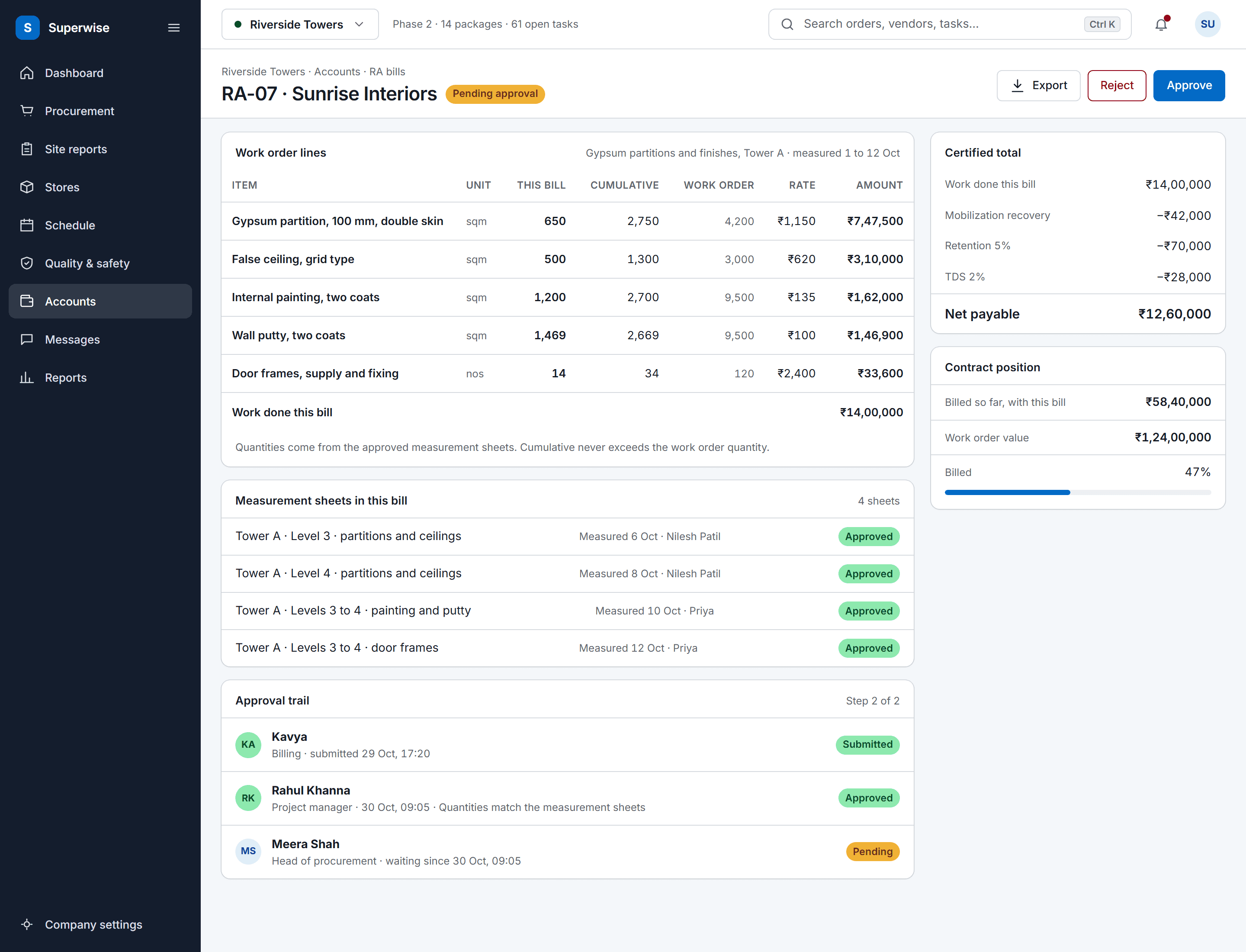
This is where digital platforms change the game. Superwise's RA Bill certification module lets clients review bills online, raise queries digitally, and certify with electronic signatures – often cutting this cycle by half.
Why Bills Get Rejected (And How to Prevent It)
| The Problem | The Prevention |
|---|---|
| Measurement discrepancies | Photograph everything; get signatures during joint verification, not after |
| Missing supporting documents | Use the submission checklist; attach challans at the time of billing, not later |
| Rate mismatches with BOQ | Lock your BOQ rates in Excel formulas so they can't be typed wrong |
| Arithmetic errors | Have your junior engineer check the senior QS's calculations |
| GST compliance issues | Validate HSN codes against the latest GST circulars before submission |
| Duplicate claims | Maintain a running cumulative quantity register; check against it religiously |
| Unauthorized items | No BOQ item number or variation order? Don't claim it yet |
RA Bill vs Final Bill: Know the Handoff
| Aspect | RA Bill (Monthly) | Final Bill (Project End) |
|---|---|---|
| Timing | Periodic progress payments | One-time final settlement |
| Scope | Work executed that month | Complete contract reconciliation |
| Retention | Deducted and held | Released (post defect liability period) |
| Adjustments | Limited to current period | Claims, variations, price escalation, bonuses/penalties |
| Documentation | Progress photos, MB entries | Completion certificates, as-built drawings, warranties |
Handoff checklist for final bill: 1. Reconcile all RA bill certified amounts 2. Verify retention withheld matches contract (usually 5% of total value) 3. Settle advance balances to zero 4. Include early completion bonuses or liquidated damages 5. Final GST adjustment invoice
Digitizing the Process: From 60 Days to 20 Days
Traditional RA bill processing is paper-heavy and slow. Here's what changes with automation:
| Stage | Traditional Method | Digital Workflow |
|---|---|---|
| Measurement | Paper MB, manual copying | Mobile app with GPS, auto-sync |
| Abstract prep | Excel sheets, formula errors | Auto-generated from measurements |
| Bill drafting | Copy-paste from previous bills | Pre-populated templates |
| Submission | Physical courier, lost papers | Digital workflow with timestamps |
| Verification | Manual cross-checking | Automated validation rules |
| Certification | Physical signatures, scanning | Digital signatures, instant issue |
The real benefits: - Cycle time: 45-60 days drops to 15-25 days - Error elimination: Automated calculations remove arithmetic mistakes - Audit trail: Every change tracked with user and timestamp - Visibility: Real-time dashboards show exactly where your bill is stuck
For billing engineers and contracts teams, platforms like Superwise integrate the entire workflow – from digital measurement books to automated certification – without forcing you to abandon industry-standard formats.
Structured Data: The Foundation for AI Assistance
Here's something practical about the future: when your RA bill data is structured properly (in platforms like Superwise), you can query it with AI assistants using RAG (Retrieval-Augmented Generation).
Instead of searching through six months of files to answer "How much retention is held against Contractor XYZ?", an AI assistant can pull that instantly from your structured database.
Practical uses: - "What's the status of Tower A's structural RA bill?" - "Show me measurement history for Block B PCC work" - "Draft next month's bill based on approved measurements"
The Superwise Help Agent demonstrates how this works – turning your project documentation into an interactive knowledge base that junior engineers can query instead of interrupting senior staff.
Download: RA Bill Excel Template
To implement this process immediately, use this comprehensive Excel template:
- Measurement Book Format: Structured for joint verification signatures
- Abstract Sheet: Auto-calculating formulas for quantities and amounts
- RA Bill Format: Standard sections pre-formatted
- Deduction Calculator: Automated retention, TDS, and advance recovery
- GST Invoice Format: Compliant with Indian requirements
- Submission Checklist: Ensures completeness before sending
How to Use It
- Copy the template for each new project
- Input your BOQ items and rates in the master sheet
- Record measurements in the MB sheet during joint verification
- Populate the abstract – formulas auto-calculate amounts
- Review deductions in the calculation sheet
- Generate the bill using the pre-formatted sheet
- Submit with the checklist
Download the ready-to-use files for this article:
Complete RA Bill workbook with auto-calculating formulas for measurement books, abstract sheets, deductions (retention, TDS, advance recovery), and GST compliance. Ready for CPWD and private construction projects. Best format: Excel, because this asset is meant to be edited and reused on-site. - Download Excel template
Conclusion: Master the Process, Control the Cash Flow
The RA bill process isn't just administrative overhead – it's the financial circulatory system of your project. When it works, everyone gets paid, materials flow, and work proceeds. When it breaks down, disputes fester and projects stall.
The difference between a 30-day certification and a 90-day certification usually comes down to: 1. Disciplined measurement with proper documentation 2. Accurate abstracts with zero arithmetic errors 3. Complete submissions that don't bounce back for missing papers 4. Systematic follow-up that keeps bills moving through approval queues 5. Digital tools that eliminate friction
Whether you're recording your first measurement book entry or overseeing contracts for multiple sites, getting this process right is a career-defining skill in Indian construction.
Ready to cut your billing cycle time in half? Request a demo to see how automation handles the RA bill workflow while keeping your established standards intact.
FAQ: RA Bill Process in Construction
Q1: What's the standard retention percentage in Indian construction contracts?
Usually 5-10% of each RA bill, capped at 5% of total contract value. Released after the defect liability period (12-24 months).
Q2: How often should RA bills be submitted?
Monthly is standard – for work up to the last day of each month. Some small contracts specify bi-monthly or quarterly.
Q3: Can I claim for materials stored on site but not yet used?
Only if your contract specifically allows "materials on site" payments. You'll need delivery challans, insurance proof, and secure storage verification.
Q4: What if the client doesn't certify within the contractual timeframe?
Most standard contracts (CPWD, state PWD, FIDIC-based) have "deemed certification" clauses. If they don't respond within 30-45 days, the bill is deemed certified. Document your follow-ups formally.
Q5: How is price escalation calculated?
Based on published indices (WPI/CPI) or material price variations from a base date specified in your contract. Claim separately with index data.
Q6: What's the difference between an interim certificate and an RA bill?
The RA bill is your claim. The interim certificate is the client's approval of what they'll actually pay (which might be less).
Q7: Is TDS deducted from retention money?
No. TDS is calculated on the gross amount first. Retention is then withheld from the remaining amount.
Example: Gross ₹100, TDS @2% = ₹2, Retention @5% on ₹98 = ₹4.90, Net = ₹93.10.
Q8: How do I handle GST if the contractor is unregistered?
If the project value exceeds RCM thresholds, the client pays GST under Reverse Charge Mechanism. Clearly indicate RCM applicability on the bill.
Q9: What documents are needed for retention release?
- Application for release
- Defect liability completion certificate
- No-dues certificate
- Final inspection report
- Original retention deduction statement
Q10: Can a client reject an entire RA bill?
Yes, for fundamental issues like forged documents or unauthorized work. More commonly, they'll certify partially and query specific items, providing written reasons for any reductions.